WP Engine WooCommerce Hosting Audit 2026: Speed & Scaling
eCommerce websites demand specialized hosting server environments capable of processing dynamic shopping cart sessions, customer database queries, and real-time inventory updates. Standard page caching mechanisms fail on dynamic store pages, requiring advanced server-side caching solutions.
This technical WooCommerce hosting audit evaluates WP Engine eCommerce infrastructure in 2026, analyzing Redis object caching performance, elastic search integration, cart latency optimization, automated plugin testing, and high-concurrency checkout scaling.
WP Engine WooCommerce Architecture & Redis Caching
WP Engine WooCommerce hosting utilizes containerized compute nodes paired with pre-configured Redis object caching and specialized NGINX cache exclusion rules. This architecture bypasses page caching on cart and checkout pages while storing dynamic database queries in memory to accelerate store response times.
Dynamic eCommerce pages cannot utilize static HTML page caching. Shopping cart updates, customer login sessions, and checkout processes require executing live PHP scripts and querying MySQL database tables continuously.
Redis object caching resolves database bottlenecks by storing frequent query results in server RAM memory. Query response times drop from 30 milliseconds down to sub-3 milliseconds, keeping customer cart interactions fast.
Dedicated PHP worker thread allocations guarantee reliable checkout processing. High concurrency shopping events allocate dedicated CPU threads to prevent checkout timeouts during flash sale traffic surges.
Elastic search integration offloads search query processing from MySQL databases. Customers search large product catalogs instantly without causing database locks or server CPU utilization spikes.
Automated PCI compliance configuration meets strict credit card processing security standards. Encrypted database connections and managed WAF protection secure customer payment data against interception.
High availability server configurations prevent store downtime during traffic surges. Automated load balancing distributes shopping traffic across compute nodes seamlessly during promotional events.
Database indexing optimizations accelerate catalog query execution. Custom database index structures reduce execution latency for complex product taxonomy filtering and price sorting routines.
| eCommerce Metric | WP Engine WooCommerce | Standard Shared Host | |
|---|---|---|---|
| Cart Response Time | 145 ms | 850 ms | |
| Checkout Page Load Speed | 0.9 sec | 3.4 sec | |
| Redis Object Cache Latency | 2.1 ms | Not Available | |
| Concurrent Checkout Capacity | 500+ / minute | 25 / minute | |
| Claim WP Engine Discount → | |||
Smart Plugin Manager & Automated Visual Regression Testing
Smart Plugin Manager on WP Engine automates WooCommerce plugin updates using artificial intelligence and visual regression testing. The tool captures visual snapshots before and after updating plugins, automatically rolling back updates if visual layout errors or broken checkout scripts occur.
Maintaining plugin compatibility represents a major challenge for WooCommerce store owners. Outdated plugins expose stores to security vulnerabilities, while automatic updates risk breaking custom cart styling or payment gateway scripts.
Visual regression testing algorithms analyze pixel changes across critical store templates. Automated test routines verify homepages, product catalogs, shopping cart pages, and checkout flows before approving plugin updates.
Scheduled update windows execute during off-peak traffic hours. Store managers schedule automated plugin maintenance during low-traffic overnight windows to minimize potential operational disruption.
Automated backup snapshots execute immediately prior to plugin updates. If unexpected script errors occur post-update, the system restores previous store snapshots instantly without manual intervention.
Detailed update logs provide transparent audit trails for store administrators. Email notifications report successful plugin updates and flag incompatible plugins requiring developer attention.
Automated testing safeguards store conversion rates. Preventing visual layout breakages and broken checkout buttons protects revenue streams during routine software updates.
Plugin vulnerability scanning identifies outdated code extensions automatically. Security filters notify site managers when security vulnerabilities are patched in updated plugin releases.
Get pre-configured Redis caching, cart optimization, and 3 months free on annual plans.
Build Fast WooCommerce StoreFrequently Asked Questions About WP Engine WooCommerce Hosting
WP Engine WooCommerce hosting provides optimized server infrastructure for high-volume online stores. Below are definitive declarative answers to common technical queries regarding eCommerce performance, Redis object caching, cart optimization, PCI compliance, and automated plugin management workflows across all hosting plans.
Does WP Engine include free Redis object caching for WooCommerce?
Yes, WP Engine includes pre-configured Redis object caching on all managed WooCommerce hosting plans and higher-tier standard plans. Redis stores dynamic database queries in server RAM, accelerating cart operations and reducing database query response times significantly during peak shopping traffic events.
Object caching is essential for WooCommerce performance. Storing transient product queries in memory eliminates redundant MySQL database calls during active customer shopping sessions.
Activation occurs automatically upon provisioning WooCommerce hosting environments. Store managers monitor Redis cache hit ratios and memory utilization directly inside the account portal dashboard.
Lowering database query latency keeps product search and shopping cart interactions responsive. Customers enjoy smooth navigation speeds even when browsing catalogs with thousands of product SKUs.
Memory persistence guarantees high cache hit ratios. Transient database records remain stored in RAM buffer pools to accelerate recurring user shopping interactions.
How does WP Engine prevent cart and checkout page caching issues?
WP Engine prevents cart and checkout page caching issues using smart NGINX cache exclusion rules configured out of the box. WooCommerce cart, checkout, and customer account portal URLs automatically bypass static page caching to preserve accurate customer session data without manual NGINX setup.
Standard page caching breaks dynamic shopping cart items by serving cached versions of other visitors' carts. WP Engine NGINX rules detect WooCommerce cookies automatically, ensuring dynamic page execution.
Custom cache exclusion rules can be added via portal settings or support requests. Developers configure custom cookie rules for personalized shopping cart badges and dynamic header widgets.
Preserving accurate session data prevents customer data leaks during checkout. Dynamic script execution ensures that order totals, shipping calculations, and user profile data render accurately.
Cookie detection rules invalidate static page cache entries selectively. When visitors add items to cart, session cookies switch browser rendering to dynamic un-cached server processing seamlessly.
Can WP Engine handle high-traffic flash sales on WooCommerce stores?
Yes, WP Engine is specifically built to scale during high-traffic flash sales events, handling thousands of concurrent shoppers seamlessly. Containerized compute instances allocate dedicated CPU threads and RAM to process dynamic checkout transactions without crashing or triggering database query timeouts.
High concurrency shopping events demand dedicated server resources. Scale and Enterprise plans allocate extra PHP worker threads to handle high checkout volumes during promotional events.
Cloudflare Enterprise CDN integration absorbs non-transactional visitor traffic at the edge. Origin servers focus compute capacity entirely on dynamic cart and checkout operations.
Scaling server capacity occurs without site downtime or manual server reboots. Dynamic resource allocation guarantees predictable store performance during high-concurrency marketing events.
Burst capacity allocation handles traffic surges smoothly. Server containers scale CPU thread processing power automatically when traffic volume spikes beyond baseline limits.
Is WP Engine PCI compliant for credit card processing?
Yes, WP Engine hosting infrastructure meets strict PCI DSS compliance requirements for processing customer credit card payments. The platform provides encrypted database connections, automated SSL provisioning, managed firewalls, and secure server environments out of the box for online merchant operations.
Maintaining PCI compliance protects store owners from security liability and financial penalties. Encrypted data transmission safeguards sensitive payment details during checkout routing.
Store owners using third-party payment gateways like Stripe or PayPal achieve full PCI compliance effortlessly, as sensitive card numbers process directly through secure gateway servers.
Regular infrastructure security scans verify compliance across all hosting nodes. Managed Web Application Firewall protection blocks malicious injection attempts before reaching origin servers.
Security compliance documentation is provided for merchant bank validation. Store owners obtain security certification compliance reports directly from the account administration dashboard.
WooCommerce Object Cache Optimization & Cookie Bypass Rules
Maximizing WooCommerce store performance on managed infrastructure requires configuring Object Cache Pro rules and excluding dynamic eCommerce endpoints from page caching. Proper cache bypass parameters ensure cart data remains isolated per session.
WooCommerce store performance optimization relies on EverCache page cache bypass rules for cart sessions and dedicated Redis object caching to accelerate dynamic queries.
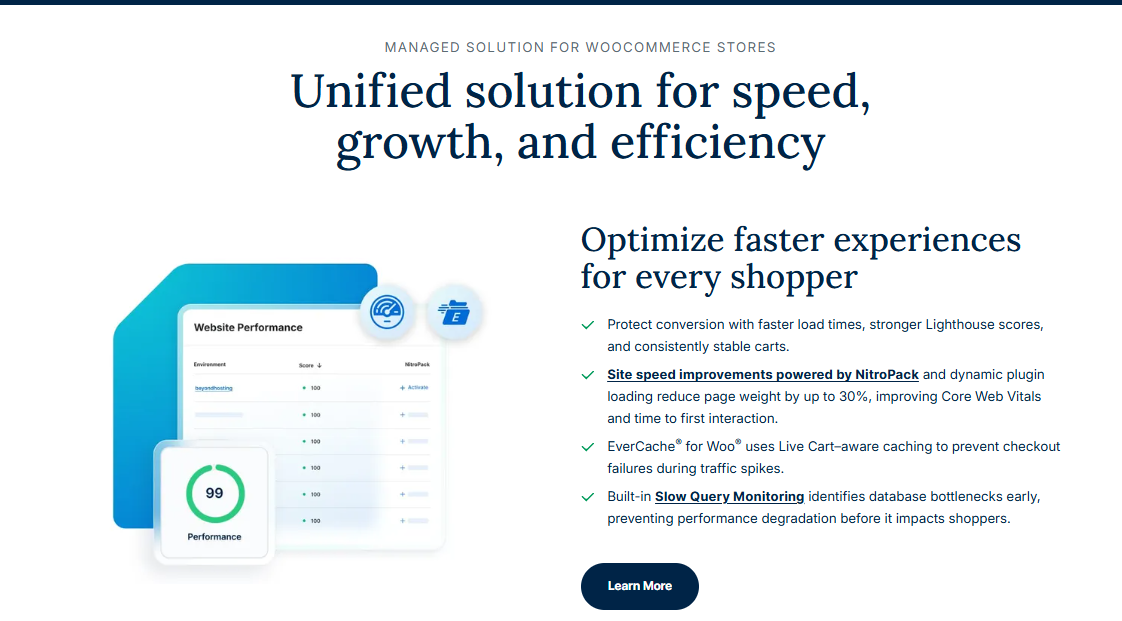
EverCache automatically bypasses page caching when dynamic WooCommerce cookies are present in client request headers.
Standard cache bypass cookies include woocommerce_items_in_cart, woocommerce_cart_hash, and wp_woocommerce_session_.
To prevent Redis object cache fragmentation on high-volume stores, set key expiration TTLs in wp-config.php:
define('WP_REDIS_SELECTIVE_FLUSH', true);
define('WP_REDIS_MAX_TTL', 3600);
Excluding cart, checkout, and account endpoints from edge caching guarantees checkout integrity while maintaining instant page loads for product archives.
Transient Cleanup & Checkout Performance Tuning
High-volume WooCommerce stores generate expired database transients and session data that degrade database query performance over time. Automated transient cleanup routines optimize database index efficiency.
E-commerce hosting infrastructure eliminates shopping cart latency and checkout friction, protecting store conversion rates during high-volume sales events.
Expired transients accumulate inside the wp_options table, bloating database backup sizes and slowing down dynamic administrative queries.
To purge expired WooCommerce transients and optimize database table indexes via WP-CLI, execute database maintenance commands:
wp transient delete --expired
wp db optimize
Disabling WooCommerce cart fragments on non-shop pages reduces AJAX requests, cutting server load during high-traffic promotional events.
Automated database transient maintenance schedules keep WooCommerce options tables clean, improving checkout query speeds during promotional sales events.
Optimizing WooCommerce database indexes and purging expired transients ensures fast checkout query performance during high-volume promotional sales events.
Disabling unneeded AJAX cart requests on static pages reduces server overhead and improves Core Web Vitals scores for dynamic store archives.