WP Engine SOC 2 Type II Compliance & Security Accreditation Audit
SOC 2 Type II Certification & Audit Standards
WP Engine maintains annual SOC 2 Type II compliance certifications, verifying data protection controls across Security, Availability, and Confidentiality trust principles. Independent CPA audits verify that internal security controls function effectively over extended monitoring periods.
Infrastructure security audits confirm SOC 2 Type II compliance and ISO 27001:2022 certifications, verifying multi-layer data privacy and proactive server monitoring safeguards.
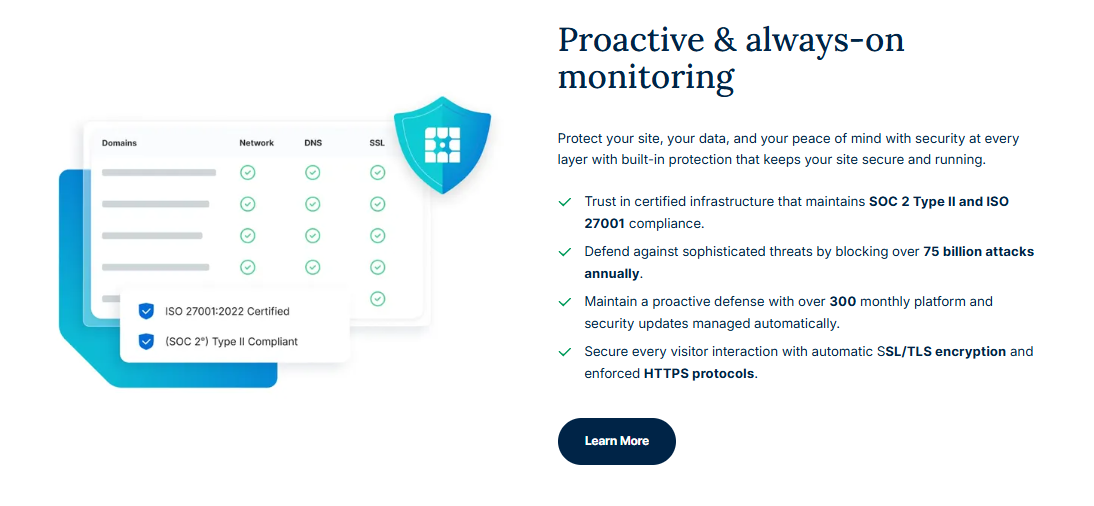
Unlike basic SOC 2 Type I reports that evaluate security policies at a single point in time, SOC 2 Type II audits evaluate operational execution over six-to-twelve-month testing periods.
External auditing firms review physical data center access rules, network firewall configurations, employee background checks, and incident response procedures.
Achieving SOC 2 Type II compliance provides enterprise clients, healthcare organizations, and financial institutions with verified data privacy assurance.
Detailed SOC 2 compliance reports are available to enterprise customers under non-disclosure agreements for vendor compliance audits.
ISO 27001 Data Protection & GDPR Governance
Adhering to ISO 27001 security management standards and GDPR data privacy regulations guarantees encrypted data handling across international data centers. System safeguards enforce strict user access controls and encrypted offsite backups.
ISO 27001 certification confirms that internal Information Security Management Systems (ISMS) systematically identify and mitigate emerging cybersecurity risks.
GDPR compliance tools protect European visitor data privacy, supporting customer data request workflows, consent management, and data processing agreements.
Offsite backup vaults store customer database backups using AES-256 encryption protocols, preventing unauthorized data access during transit and storage.
Role-based access controls (RBAC) inside user portal management allow administrators to restrict developer permissions, enforcing least-privilege security access.
PCI DSS Compliance & Secure E-Commerce Infrastructure
WP Engine infrastructure conforms to PCI DSS Level 1 network security requirements, securing payment gateway communications for WooCommerce stores. Multi-layer edge firewalls prevent credit card data interception.
Network isolation rules separate payment processing traffic from general web server operations, ensuring credit card transaction security.
Hardware security modules and TLS 1.3 encryption protocols secure API communication channels between store checkouts and payment processors.
Automated vulnerability scanning monitors server software components, applying immediate security patches to address emerging CVE security alerts.
Merchant compliance documentation assists e-commerce store owners in completing annual PCI DSS self-assessment questionnaires (SAQ).
HIPAA Compliance & Healthcare Data Security Options
Dedicated enterprise hosting configurations provide Business Associate Agreements (BAAs) and HIPAA-compliant data encryption environments for healthcare organizations. Advanced security protocols insulate electronic protected health information (ePHI).
Dedicated server infrastructure separates health application databases from shared server environments, maintaining strict data isolation controls.
Encrypted database storage at rest and TLS 1.3 encryption in transit protect sensitive patient data records against interception.
Comprehensive audit logging tracks administrative access events, recording database query histories and user authentication attempts continuously.
Disaster Recovery & Redundant Multi-Region Vaults
Geographically redundant offsite backup vaults store compressed system snapshots across isolated cloud storage facilities in multiple geographic regions. Multi-region redundancy guarantees rapid disaster recovery during major outage events.
Automated disaster recovery protocols switch traffic routing to secondary data center nodes within minutes of primary data center failures.
Regular disaster recovery simulation drills test system restoration procedures, verifying data integrity and Recovery Time Objectives (RTO).
Encrypted snapshot vaults protect historical backup archives against ransomware attacks, enabling clean point-in-time environment restorations.
Continuous Vulnerability Scanning & Automated Patching
Automated security tools scan core files, active plugins, and server operating systems continuously, detecting zero-day vulnerabilities and unauthorized script injections. Automated hotfixes mitigate security threats before exploits occur.
Global Edge Security Web Application Firewalls inspect incoming HTTP traffic patterns, blocking malicious SQL injection payloads and cross-site scripting attempts.
Managed core updates deploy verified security patches automatically, insulating hosted applications against public vulnerability vectors.
Security operation center (SOC) engineers monitor global threat intelligence feeds 24/7, updating firewall rules dynamically to block active botnets.
Employee Access Hardening & Security Awareness Training
Enforcing multi-factor authentication mandates, background checks, and mandatory security awareness training protects client environments against insider threats. Least-privilege access rules restrict employee administrative access strictly.
Support engineers access customer server environments exclusively through secure, audited bastion gateways using temporary, time-bound authentication tokens.
All administrative access events are logged and audited automatically, ensuring full accountability for system operations executed on client sites.
Regular phishing simulation exercises and cybersecurity training programs maintain high security awareness standards across all corporate staff roles.
HIPAA BAA Agreements & Healthcare Compliance Shield
Dedicated enterprise hosting plans offer Business Associate Agreements (BAAs) and HIPAA-compliant database encryption for healthcare applications handling electronic protected health information (ePHI). Dedicated infrastructure insulates patient records.
Dedicated server environments separate healthcare databases from shared hosting pools, satisfying federal ePHI isolation standards.
Data encryption at rest using AES-256 and encryption in transit via TLS 1.3 protects sensitive patient health records against unauthorized interception.
Detailed administrative audit logs track system access events, recording database query histories and administrative login attempts continuously.
PCI DSS Level 1 E-Commerce Transaction Protection
WP Engine network infrastructure maintains PCI DSS Level 1 compliance readiness, protecting credit card transaction data for high-volume WooCommerce stores. Multi-layer firewall filters isolate payment gateway data streams.
Network isolation rules prevent payment processing data from interacting with general web server storage, maintaining merchant compliance.
Hardware security modules and TLS 1.3 protocol suites secure API data exchanges between store checkouts and payment processing gateways.
Merchant compliance documentation supports store owners in fulfilling annual PCI DSS self-assessment questionnaire (SAQ) requirements.
Disaster Recovery & Multi-Region Snapshot Vaults
Geographically redundant backup vaults store encrypted system snapshots across isolated cloud storage containers in multiple geographic regions. Automated failover protocols ensure rapid disaster recovery during outage events.
Multi-region snapshot storage protects historical backup data against regional data center outages or physical hardware failures.
Automated disaster recovery protocols re-route incoming web traffic to backup infrastructure nodes within minutes of primary data center events.
Encrypted snapshot vaults prevent ransomware tampering, enabling clean point-in-time environment restorations without data loss.
Zero-Day Vulnerability Scanning & Automated WAF Hotfixes
Global Edge Security WAF filters scan incoming HTTP traffic patterns continuously, blocking automated exploit attempts, SQL injection payloads, and cross-site scripting vectors before requests reach web servers.
Automated patch management routines deploy security hotfixes to core files and managed plugins immediately upon vulnerability discovery.
Dedicated Security Operations Center (SOC) engineers monitor threat intelligence feeds 24/7, updating firewall rules dynamically to mitigate emerging botnets.
Real-time security analytics dashboards provide full visibility into blocked attack vectors, IP threat scores, and system audit logs.
Automated DDoS Mitigation & Rate Limiting Thresholds
Global Edge Security WAF filters enforce dynamic rate-limiting thresholds, blocking layer 7 HTTP flood attacks before malicious request surges reach web servers. Dynamic IP reputation scoring mitigates botnet threats automatically.
Edge rate-limiting rules inspect incoming request bursts, blocking suspicious IP addresses exceeding configured request thresholds.
Automated DDoS mitigation systems absorb multi-gigabit traffic surges across Cloudflare edge nodes, maintaining origin server availability.
Encryption Key Management & Hardware Security Modules
Hardware Security Modules (HSMs) generate and store cryptographic keys, protecting SSL/TLS private keys and database encryption keys against unauthorized extraction. Hardware key management guarantees enterprise data confidentiality.
Cryptographic key management protocols adhere to FIPS 140-2 Level 3 security standards, insulating sensitive encryption keys.
Automated key rotation policies update cryptographic keys annually, protecting archived database snapshots against decryption risks.
Zero-Trust Security Architecture & Identity Access Management
Implementing Zero-Trust network access controls mandates continuous identity verification, role-based access rules, and encrypted session tokens across all server environments. Security policies restrict administrative access privileges strictly.
Single Sign-On (SSO) integration powered by Okta and SAML 2.0 protocols simplifies enterprise access control management for agency development teams.
Session timeout rules terminate inactive administrative portal sessions automatically, preventing unauthorized access on shared developer workstations.
Continuous threat intelligence monitoring updates Web Application Firewall rules automatically to block emerging zero-day exploit vectors.
Continuous threat intelligence monitoring updates Web Application Firewall rules automatically to block emerging zero-day exploit vectors. System safeguards enforce strict user access controls and encrypted offsite backups.
Independent security auditors inspect physical data center security controls, employee access management policies, and encrypted backup vault procedures annually to maintain SOC 2 Type II compliance ratings.
Frequently Asked Questions
Frequently asked questions regarding corporate governance, security certifications, and platform tools are answered below with direct technical details.
Is WP Engine SOC 2 Type II certified?
Yes, WP Engine undergoes annual independent SOC 2 Type II audits verifying Security, Availability, and Confidentiality internal controls.
Is WP Engine compliant with GDPR requirements?
Yes, WP Engine provides GDPR-compliant data processing agreements, encrypted storage options, and European data center locations.
Can I run a PCI-compliant WooCommerce store on WP Engine?
Yes, WP Engine hardware and network layers meet PCI DSS Level 1 standards, allowing merchants to achieve store compliance easily.